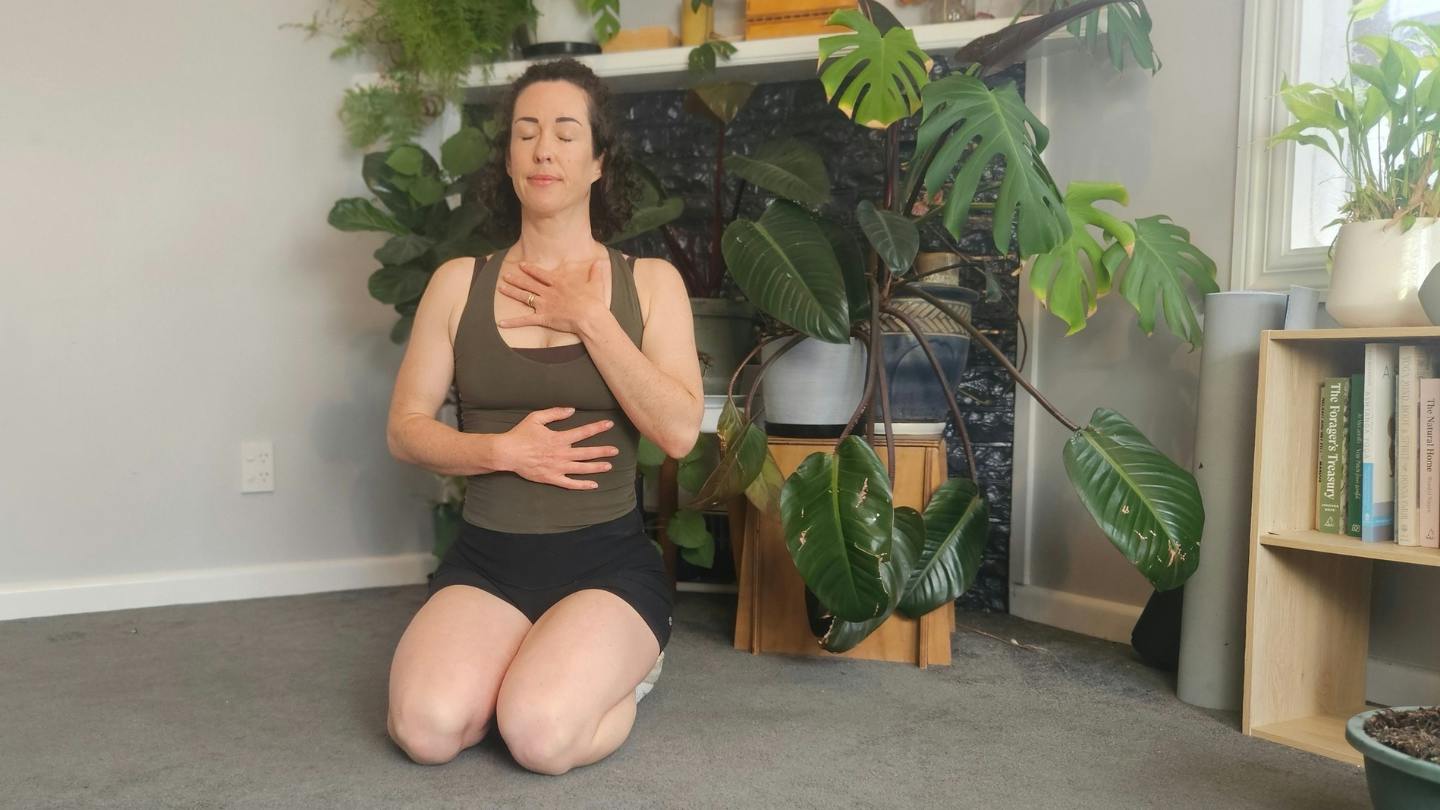
"Brace like someone's about to punch you." I've heard that cue in so many classes over the years, and I get why it's popular. But for a lot of women, it does the opposite of what we're after.
I don't really think of cues as good or bad. What I've noticed is that some cues make some women bear down on their pelvic floor instead of lifting it. And some women find it really hard to consciously feel their core at all. For them, I lean on alignment and breath instead, and let the core switch on by itself.
So if you've never quite felt your core "switch on", don't stress. You probably just haven't found the cue that works for you yet. Below are the ones I use most, plus a quick way to test them on yourself.
Your deep core in 30 seconds
Quick anatomy lesson, I promise. Your deep core is a team of muscles that work together to manage the pressure inside your body.
- Your pelvic floor sits at the bottom, like a hammock holding up your bladder, bowel and uterus.
- Your transverse abdominis (TA) is your deepest tummy muscle and wraps around your middle like a corset.
- Your diaphragm sits on top, under your ribs, and moves every time you breathe.
About 70% of your deep core is reflexive. It switches on by itself when you're lined up well and breathing well. So you don't need to squeeze it for every single movement. For most women, getting set up well does a lot of the work.
Why "suck it in" can backfire
These are the cues I see causing downward pressure for some women:
- "Suck in your stomach"
- "Belly button to spine"
- "Brace like someone is going to punch you"
- And for some, "pull your ribs together" or "tighten everything"
If you don't yet have a good feel for your deep core, it's really easy to grip with your external obliques (your outer tummy muscles) and skip the pelvic floor and TA altogether. When that happens, the pressure can get pushed down onto your pelvic floor.
You might notice leaking, heaviness or pain. I'm not saying never use these cues. Some women do really well with them. They just don't suit everyone.
The cues I use most
Have a go at these while you read. One might click straight away, or it might take a few tries.
1. Lift and wrap
Gently lift your pelvic floor, then wrap your TA between your front hip bones (low on your belly). Keep it gentle. It should feel like a lift and a hug, not a maximum squeeze.
2. Zip up your low rider jeans
Imagine you're doing up a pair of low rider jeans. The wrap should happen low, in your lower belly and the front of your pelvis between your hip points.
3. Stack your ribs over your hips and lengthen your spine
When your ribs sit over your hips, your two diaphragms (the one you breathe with and your pelvic floor) line up and can work together to manage pressure. A lot of women I work with get stuck in a rib flare, where the bottom ribs pop forward. It's often from tight lats and shoulders, and it throws your deep core off before you've even started moving.
4. The bowl of water
Picture your pelvis as a bowl of water, filled right to the brim. Tip it forward and the water spills out the front. Tip it back and it spills out the back. Bring it back to neutral and the water stays put. For lots of women, finding neutral is all it takes for the deep core to switch on.
5. Lift your baby up and hug them in
If you're pregnant, imagine you're lifting your baby up with your pelvic floor and giving them a gentle hug towards your spine with your lower belly. I use this one with women who aren't pregnant too. I just tell them to lift and hug their breakfast instead!
6. Inhale to prepare, exhale on the hard part
Because so much of your deep core is reflexive, breath and a long spine are enough for lots of movements. Breathe in to get ready, then breathe out on the hardest part, like standing up out of a squat or pressing the weight up. If you struggle to feel your core, start with this one.
Try it now: a 2-minute core check-in
Grab a chair and give this a go.
- Sit tall with your feet flat. Stack your ribs over your hips and lengthen through the top of your head.
- Find your bowl of water. Rock your pelvis forward and back a few times, then settle in the middle.
- Take two slow breaths. On the inhale relax and on each exhale, gently lift and wrap.
- Take two more breaths. This time, on each exhale, zip up your low rider jeans.
Which cue gave you a gentle lift and hug? Did any of them make you grip, hold your breath or push down? Go with the one that felt light and easy, and try it next time you lift.
When to see a pelvic health physio
If you're leaking, feeling heavy or experiencing pain, or you just can't feel any connection at all, please go and see a pelvic health physio. They can check what's going on and give you a plan for your body. Honestly, I think every woman would benefit from a pelvic health check at some point.

Try my How to Effectively Brace Core Connect session
If you would like to dive a little deeper, come and try my How to Effectively Brace Core Connect session on DediKate. We unpack deep core activation and practise different cues so you can take it into all your other workouts.
It's only 15 minutes, and you'll find it under Mobility and Recovery > Core Connect.
New to DediKate? Our weekly and 8-weekly memberships start with a 7-day free trial.
Start my free trialJulia x
More from the blog

4 Pregnancy and Postpartum Exercise Myths It’s Time to Let Go Of
21 Oct 2026


